Ditapis dengan

Cultivating cooperation: A strategic framework for Indonesia – Africa agric…
This paper proposes a strategic framework to strengthen agricultural partnerships between Indonesia and Africa. Relations between both regions are rooted in the 1955 Asian–African Conference and sustained through South–South and Triangular Cooperation (SSTC), knowledge exchange, and capacity building. Although Indonesia brings agricultural expertise and Africa offers vast fertile lands and …
- Edisi
- -
- ISBN/ISSN
- -
- Deskripsi Fisik
- -
- Judul Seri
- -
- No. Panggil
- Sesdilu 79-2025

Sub-Saharan Africa as strategic posts for Indonesian Diplomats
The overseas assignments of diplomats in the Indonesian Missions in Sub-Saharan Africa remain one of the Ministry of Foreign Affairs' human resource issues. The lack of interest among diplomats to be deployed to the region has resulted in lengthy vacancies, which has a negative impact on the performance of the affected missions. The situation is ironic, given that the Indonesian government has …
- Edisi
- -
- ISBN/ISSN
- -
- Deskripsi Fisik
- -
- Judul Seri
- -
- No. Panggil
- Sesparlu 73-2023
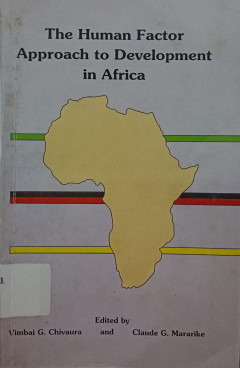
The Human factor approach to development in Africa
This book is a collection of essays exploring the concept of the "Human Factor" as a fundamental foundation for development in Africa. The authors argue that the failure of development programs on the continent is often due to a neglect of human qualities, moral responsibility, and local cultural values. The book emphasizes the importance of developing human character and integrity before imple…
- Edisi
- -
- ISBN/ISSN
- 0908307720
- Deskripsi Fisik
- xi, 240 pages ; 23 cm
- Judul Seri
- -
- No. Panggil
- 338.96 CHI h

Turning points in history book 3: Mogration land and minerals inn the making …
The book examines how migration, land distribution, and the mining industry played pivotal roles in shaping the history and development of South Africa. Through a focus on historical events and policy decisions, it explores the socio-political impact of these factors on South African society.
- Edisi
- -
- ISBN/ISSN
- 1-919855-31-9
- Deskripsi Fisik
- 80 pages : illustrations ; 24 cm
- Judul Seri
- -
- No. Panggil
- 968 NAS t
Asia and Africa: Fundamental changes
A collection of analytical essays discussing major political, social, and economic transformations occurring in Asia and Africa during the mid-twentieth century. Edited by Soviet scholars, the book examines decolonization, national liberation movements, and the emergence of newly independent states. It highlights ideological, cultural, and geopolitical shifts that shaped Asia-Africa relations i…
- Edisi
- -
- ISBN/ISSN
- -
- Deskripsi Fisik
- 384 pages ; 16,5 cm
- Judul Seri
- -
- No. Panggil
- 327.5 PAV a
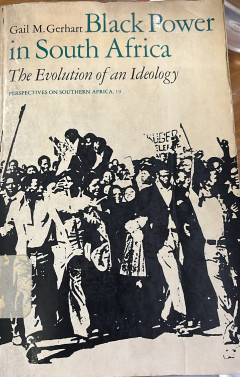
Black power in South Africa: The evolution of an ideology
This book examines the rise and development of the Black Power movement in South Africa as an ideological response to apartheid and racial domination. Written by Gail M. Gerhart, the work traces the historical roots, philosophical foundations, and political impact of Black Consciousness and related movements from the 1960s onward. Through detailed analysis, the author explores how Black Power s…
- Edisi
- -
- ISBN/ISSN
- 0-520-03933-5
- Deskripsi Fisik
- xi, 364 pages ; 22 cm
- Judul Seri
- -
- No. Panggil
- 968.06 GER b
Asian-African conference: Live and let live in “Unity in diversity”
This publication presents an overview of the Asian-African Conference and its guiding principle, “Live and Let Live in Unity in Diversity.” It highlights the historical background, political significance, and outcomes of the 1955 Bandung Conference, which brought together leaders from Asia and Africa to promote peace, solidarity, and cooperation among newly independent nations. The book emp…
- Edisi
- -
- ISBN/ISSN
- -
- Deskripsi Fisik
- 302 pages : illustrations ; 20,5 cm
- Judul Seri
- -
- No. Panggil
- 327.172 COM a
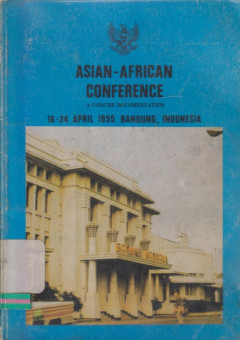
Asian-African Conference: A Concise Documentation
This concise documentation provides an overview of the historic Asian-African Conference held in Bandung, Indonesia, on 18–24 April 1955. Published by the Department of Information of the Republic of Indonesia, the book summarizes key events, participating countries, resolutions, speeches, and the political context that shaped the conference. It highlights the emergence of Asian-African solid…
- Edisi
- -
- ISBN/ISSN
- -
- Deskripsi Fisik
- 86 pages : illustrations ; 21 cm
- Judul Seri
- -
- No. Panggil
- 327.095 TIM a

Gott segne Afrika : Texte und Predigten des Friedensnobelpreisträgers
This book is a collection of texts, sermons, and reflections by Desmond Tutu, Nobel Peace Prize laureate and leading moral voice in the struggle against apartheid in South Africa. Written during a period of intense political repression, the work combines theological insight with sharp social critique, emphasizing justice, reconciliation, and human dignity. Tutu addresses the moral responsibilit…
- Edisi
- -
- ISBN/ISSN
- 3-499-15626-1
- Deskripsi Fisik
- 155 pages : Illustrations ; 19 cm
- Judul Seri
- -
- No. Panggil
- 968.065 TUT g
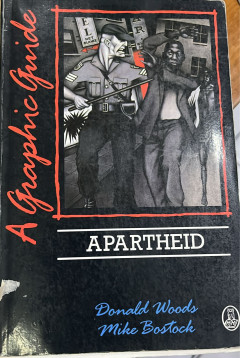
Apartheid : A Graphic guide
This book presents a concise and accessible introduction to apartheid in South Africa through a graphic narrative format. Written by Donald Woods and illustrated by Mike Bostock, it explains the origins, ideology, and implementation of apartheid policies, as well as their social, political, and human consequences. Using visual storytelling, the book highlights racial segregation, state violence…
- Edisi
- -
- ISBN/ISSN
- 0-8050-0609-5
- Deskripsi Fisik
- 148 pages : illustrations ; 21 cm
- Judul Seri
- -
- No. Panggil
- 968.065 WOO a
 Karya Umum
  Filsafat
  Agama
Agama  Ilmu-ilmu Sosial
  Bahasa
  Ilmu-ilmu Murni
  Ilmu-ilmu Terapan
  Kesenian, Hiburan, dan Olahraga
  Kesusastraan
  Geografi dan Sejarah