Ditapis dengan
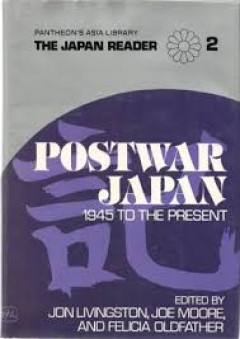
Postwar Japan 1945 to the present
Postwar Japan: 1945 to the Present is an anthology that chronicles Japan’s political, social, and economic transformations in the aftermath of World War II. Edited by Jon Livingston, Joe Moore, and Felicia Oldfather, the volume collects essays, primary sources, and commentary from scholars to provide a comprehensive view of Japan’s reconstruction under Allied occupation, its democratization…
- Edisi
- -
- ISBN/ISSN
- 0-394-70669-2
- Deskripsi Fisik
- xxi, 598 pages ; 20 cm
- Judul Seri
- -
- No. Panggil
- 952.04 LIV p
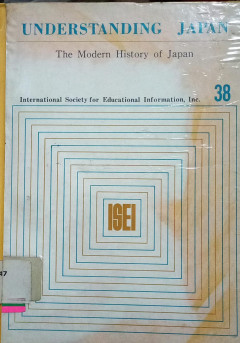
The Modern history of Japan
a concise and accessible account of Japan’s development from the Meiji Restoration (1868) to the post–World War II era. The book covers key political, economic, and social changes, including industrialization, modernization of institutions, rise of imperialism, militarism, and Japan’s transformation into a modern state. Yasuoka also discusses the impact of war, especially World War II, an…
- Edisi
- -
- ISBN/ISSN
- -
- Deskripsi Fisik
- 135 pages : illustrations ; 26 cm
- Judul Seri
- -
- No. Panggil
- 942.047 YAS m

Hiroshima and nagasaki: The Physical, medical, and social effects of the atom…
A detailed historical analysis of the United States’ decision to deploy atomic weapons against Japan in August 1945. Feis examines the strategic, political, and military factors that led to this unprecedented action, exploring alternatives such as a conventional invasion, coercion through diplomatic inducement, and the shock of the atomic bomb itself.
- Edisi
- -
- ISBN/ISSN
- 0-465-02985-X
- Deskripsi Fisik
- xli, 705 pages : illustrations ; 23,5 cm
- Judul Seri
- -
- No. Panggil
- 940.5426 LIN h

Unbeaten tracks in Japan: An Account of travels in the interior, including vi…
Nineteenth-century English traveler, writer, and natural historian Isabella Bird contributes this stunning narrative to the genre of early travelogues about Japan. The volume Unbeaten Tracks in Japan includes a series of essays recounting Bird's months-long sojourn in the Far East. Already a treat for fans of 19th century travel literature, the book is rendered all the more unique by virtue of …
- Edisi
- -
- ISBN/ISSN
- 0-8048-1000-1
- Deskripsi Fisik
- xxv, 336 pages : illustrations ; 18 cm
- Judul Seri
- -
- No. Panggil
- 910.0252 BIR u

Day of the bomb: Countdown to hiroshima
A detailed narrative of the political, military, and scientific decision-making that led to the dropping of the first atomic bomb on Hiroshima. Drawing on hundreds of interviews and thousands of documents, including previously unpublished material, Kurzman reconstructs the key moments and personalities behind the Manhattan Project and the U.S. leadership’s debate over using the bomb.
- Edisi
- -
- ISBN/ISSN
- 0-07-035688-2
- Deskripsi Fisik
- xiv, 544 pages : illustrations ; 17,5 cm
- Judul Seri
- -
- No. Panggil
- 940.5425 KUR d
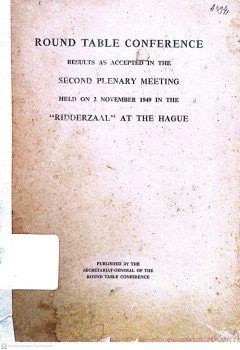
Round table conference
This publication presents the official results of the Round Table Conference as accepted in the Second Plenary Meeting held on 2 November 1949 in the Ridderzaal, The Hague. The document outlines the political agreements negotiated between the Kingdom of the Netherlands and the Republic of Indonesia, including the terms for the transfer of sovereignty, the formation of the Republic of the United…
- Edisi
- -
- ISBN/ISSN
- -
- Deskripsi Fisik
- 182 pages ; 19 cm
- Judul Seri
- -
- No. Panggil
- 959.8 SEC r
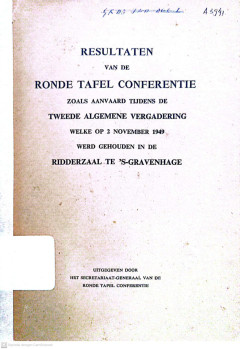
Resultaten van de ronde tafel conferentie
This volume contains the official results of the 1949 Round Table Conference held in the Ridderzaal, The Hague, as adopted during the Second General Meeting on 2 November 1949. The document presents the agreements between the Kingdom of the Netherlands and the Republic of Indonesia regarding the transfer of sovereignty, the establishment of the Republic of the United States of Indonesia (RUSI),…
- Edisi
- -
- ISBN/ISSN
- -
- Deskripsi Fisik
- 182 pages ; 19 cm
- Judul Seri
- -
- No. Panggil
- 959.8 SEC r

In Love with a nation: Molly Bondan and Indonesia her own story in her own words
This is the story of Molly Bondan (1912–1990), a remarkable Australian who spent more than half of her life in Indonesia. With her Indonesian husband, who had been a political prisoner of the colonial Dutch, she went to Yogyakarta during the war for Indonesia's Independence. Molly worked for the Indonesian Department of Foreign Affairs in Jakarta for many years. From 1951 to 1965 she wrot…
- Edisi
- -
- ISBN/ISSN
- -
- Deskripsi Fisik
- xvi, 240 pages ; 21 cm
- Judul Seri
- -
- No. Panggil
- 959.8 HAR l

Riyadh heart of Arabia
Riyadh: Heart of Arabia is a richly illustrated photographic journey through Saudi Arabia’s capital region, written by Mohsen Al-Dajani (a Bedouin-born pilot) with co-author Brian Salter. Over three years, the authors document the city’s past and present — from mud-brick palaces, modern skyscrapers, and bustling souqs, to archaeological sites and the rugged natural beauty of its surroundi…
- Edisi
- -
- ISBN/ISSN
- 978-603-01-0376-8
- Deskripsi Fisik
- 232 pages : iilustrations ; 30 cm
- Judul Seri
- -
- No. Panggil
- 915.311104 ALD r
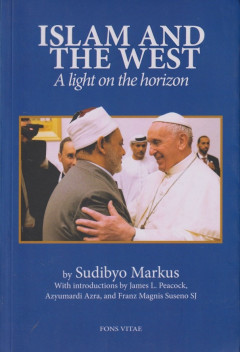
Islam and the west: A Light on the horizon
“Islam and the West: A Light on the Horizon,” written by Sudibyo Markus, explores the dynamics between the Islamic world and Western societies from historical, social, and spiritual perspectives. The author examines the challenges and misunderstandings that often arise in the interaction between these two major civilizations, while offering a dialogical approach grounded in humanistic and e…
- Edisi
- -
- ISBN/ISSN
- 978-1941610-923
- Deskripsi Fisik
- 388 pages : illustration ; 23 cm
- Judul Seri
- -
- No. Panggil
- 909.09767 MAR i
 Karya Umum
  Filsafat
  Agama
Agama  Ilmu-ilmu Sosial
  Bahasa
  Ilmu-ilmu Murni
  Ilmu-ilmu Terapan
  Kesenian, Hiburan, dan Olahraga
  Kesusastraan
  Geografi dan Sejarah