Ditapis dengan

My Life
My Life is the autobiography of Grand Admiral Erich Raeder, one of the most influential figures in the German navy in the first half of the 20th century. It chronicles his life from his military training through his involvement in the rebuilding of the German fleet, to his role as commander of the Kriegsmarine during World War II. Raeder offers a personal perspective on naval warfare strategy, …
- Edisi
- -
- ISBN/ISSN
- -
- Deskripsi Fisik
- xvii, 430 pages : illustration ; 23,5 cm
- Judul Seri
- -
- No. Panggil
- 359.0092 RAE m

Revolutions and revolutionary movements
This book provides a comprehensive analysis of various revolutions and revolutionary movements in the modern world. James DeFronzo discusses the social, economic, political, and psychological factors that drive revolutions, as well as how these movements develop and influence the social order. By reviewing a number of case studies from different countries, this book highlights common patterns i…
- Edisi
- -
- ISBN/ISSN
- 0-8133-0668-X
- Deskripsi Fisik
- xvi, 336 pages : illustration ; 23 cm
- Judul Seri
- -
- No. Panggil
- 303.64 DEF r

War and decision: Inside the pentagon at the dawn of the war on terrorism
This book is a firsthand account of Douglas J. Feith, U.S. Under Secretary of Defense for Policy during President George W. Bush's early term after the September 11, 2001, attacks. In War and Decision, Feith details the Pentagon's decision-making process, the internal dynamics of the U.S. government, and the strategies that shaped the global war on terrorism. The book provides in-depth insights…
- Edisi
- -
- ISBN/ISSN
- 978-0-06-089973-8
- Deskripsi Fisik
- xiv, 674 pages : illustration ; 23,5 cm
- Judul Seri
- -
- No. Panggil
- 355.0217 FEI w

State succession to treaties in respect of newly independent African States
This book examines the issue of state succession in relation to international treaties, particularly for newly independent African states following decolonization. Mutiti outlines how these states must determine the status of treaties inherited from colonial powers and the various international legal approaches related to this issue. The analysis is presented through a historical overview, inte…
- Edisi
- -
- ISBN/ISSN
- -
- Deskripsi Fisik
- 126 pages : illustrations ; 21,5 cm
- Judul Seri
- -
- No. Panggil
- 341.026 MUT s

Battle for our minds: Western elites and the terror threat
This book examines how Western political elites, media outlets, and academics have unwittingly undermined counterterrorism efforts. Michael Widlanski examines terrorist groups' communication strategies, the manipulation of public opinion through the media, and the failure of intelligence analysis to understand ideological threats. Using psychological and geopolitical approaches, this book highl…
- Edisi
- -
- ISBN/ISSN
- 978-1-4516-5903-0
- Deskripsi Fisik
- v, 394 pages ; 24 cm
- Judul Seri
- -
- No. Panggil
- 363.3250973 WID b
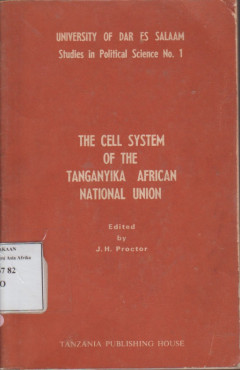
The Cell system of the tanganyika African national union
This book examines the cell system within the Tanganyika African National Union (TANU), the political party that led Tanzania's independence struggle under Julius Nyerere. This organizational model emphasized the formation of small political units at the village and community levels as a method of mass mobilization, political education, and the consolidation of the Ujamaa ideology. Edited by J.…
- Edisi
- -
- ISBN/ISSN
- -
- Deskripsi Fisik
- vi, 66 pages : illustration ; 21,5 cm
- Judul Seri
- -
- No. Panggil
- 320.678 PRO c
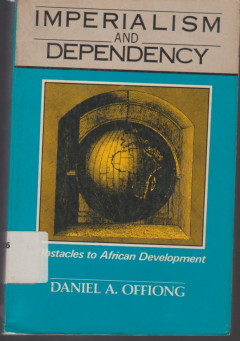
Imperialism and dependency: Obstacles to African development
Daniel A. Offiong's book, Imperialism and Dependency, examines how imperialism and structures of international dependency have become major obstacles to Africa's economic development. Offiong examines the unequal global economic relations between developed and developing countries, explaining how colonialism and modern economic practices have created patterns of dependency that hinder Africa's …
- Edisi
- -
- ISBN/ISSN
- 0-88258-127-9
- Deskripsi Fisik
- xxvi, 483 pages ; 21,5 cm
- Judul Seri
- -
- No. Panggil
- 338.96 OFF i
The United States of Africa
The book "The United States of Africa" is a collection of political thoughts by Guinean President Ahmed Sékou Touré on the unity of the African continent. In this work, he outlines a vision for the formation of a unified African nation-state as a path to true independence, solidarity, and development. The book discusses the concept of African political, economic, and social integration,…
- Edisi
- -
- ISBN/ISSN
- -
- Deskripsi Fisik
- 352 pages ; 24 cm
- Judul Seri
- -
- No. Panggil
- 320.96 TOU u
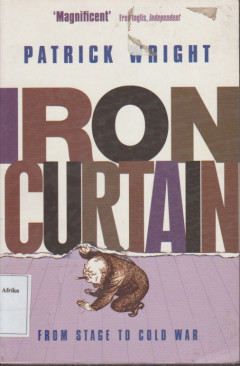
Iron curtain: From stage to cold war
Patrick Wright's Iron Curtain: From Stage to Cold War traces the development of the term "iron curtain" from 19th-century theater to its role as a key geopolitical metaphor during the Cold War. It explains how the concept of the "Iron Curtain" was shaped through performance art, propaganda, and European political dynamics, and then popularized by Winston Churchill in a 1946 speech. Wright outli…
- Edisi
- -
- ISBN/ISSN
- 978-0-19-923150-8
- Deskripsi Fisik
- xvi, 488 pages : illustration ; 20 cm
- Judul Seri
- -
- No. Panggil
- 327.12 WRI i

Clash of titans: Africa and U.S. foreign policy
This book examines the dynamics of relations between the United States and African countries during the Cold War. Edward W. Chester analyzes America's strategic, political, and economic interests in Africa, and how US foreign policy shaped African political developments. This work evaluates global conflicts of interest, the influence of great powers, and the responses of African countries to in…
- Edisi
- -
- ISBN/ISSN
- 0-88344-065-2
- Deskripsi Fisik
- ix, 361 pages ; 24 cm
- Judul Seri
- -
- No. Panggil
- 327.7306 CHE c
 Karya Umum
  Filsafat
  Agama
Agama  Ilmu-ilmu Sosial
  Bahasa
  Ilmu-ilmu Murni
  Ilmu-ilmu Terapan
  Kesenian, Hiburan, dan Olahraga
  Kesusastraan
  Geografi dan Sejarah