Ditapis dengan

The Force of fantasy: Restoring the American dream
The Force of Fantasy explores how symbolic communication, storytelling, and rhetorical vision shape American social and political life. Ernest G. Bormann examines the ways collective fantasies influence public opinion, national identity, and political decision-making. Through his analysis of rhetorical movements and shared fantasies, the book demonstrates how narratives help restore, reform, or…
- Edisi
- -
- ISBN/ISSN
- 0-8093-1185-2
- Deskripsi Fisik
- ix, 279 pages ; 23,5 cm
- Judul Seri
- -
- No. Panggil
- 302.2 BOR f
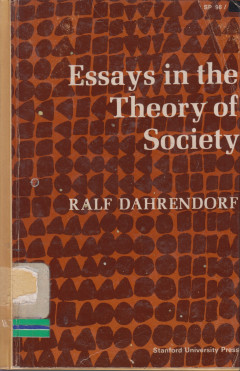
Essays in the theory of society
This volume brings together ten influential essays by renowned sociologist Ralf Dahrendorf, offering a comprehensive exploration of major themes in sociological theory. Covering issues such as social conflict, authority, class structure, and the origins of inequality, the essays reflect Dahrendorf’s distinctive analytical approach that bridges classical and modern sociological thought. Severa…
- Edisi
- -
- ISBN/ISSN
- -
- Deskripsi Fisik
- x, 300 pages ; 21,5 cm
- Judul Seri
- -
- No. Panggil
- 301.01 DAH e

Alexis de Tocqueville: His social and political theory
Whitney Pope's Alexis de Tocqueville: His Social and Political Theory provides a comprehensive study of the social and political thought of Alexis de Tocqueville, one of the most influential theorists in the history of the social sciences. Pope examines Tocqueville's ideas on democracy, civil society, equality, liberty, and the dangers of the tyranny of the majority, as well as their relevance …
- Edisi
- -
- ISBN/ISSN
- 0-8039-2557-3
- Deskripsi Fisik
- 158 pages ; 21,5 cm
- Judul Seri
- -
- No. Panggil
- 301.0924 POP a
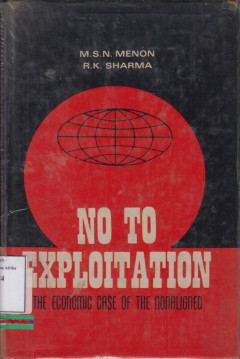
No to exploitation: The Economic sase of the non-aligned
This book examines the economic arguments underlying the Non-Aligned Movement's stance against global economic exploitation. Menon and Sharma outline the structural inequalities between developed and developing countries and offer an analysis of the need for a more equitable international economic order. Through historical, economic, and political analysis, the book explains how non-aligned cou…
- Edisi
- -
- ISBN/ISSN
- -
- Deskripsi Fisik
- xxxii, 163 pages ; 25 cm
- Judul Seri
- -
- No. Panggil
- 327.172 MEN n
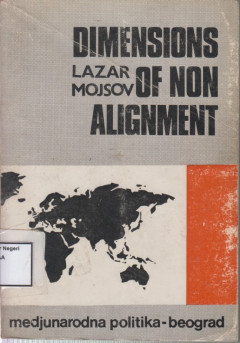
Dimensions of non-alignment
This book presents an analytical exploration of the political, strategic, and ideological dimensions of the Non-Aligned Movement, written by Lazar Mojsov, a prominent Yugoslav diplomat and statesman. It examines the evolution of non-alignment during the Cold War, the principles guiding the Movement, and the role of developing nations in shaping global political dialogue. Through historical refl…
- Edisi
- -
- ISBN/ISSN
- -
- Deskripsi Fisik
- 281 pages ; 20 cm
- Judul Seri
- -
- No. Panggil
- 327.17 MOJ d

Non-alignment in the 1990s: Contributions to an economic agenda
This publication presents a series of analytical papers and background documents prepared by the South Centre in response to a request from the Government of Indonesia during the preparations for the Tenth Non-Aligned Movement Summit in 1992. It examines major economic challenges faced by developing countries in the 1990s and outlines proposals for strengthening South–South cooperation and pr…
- Edisi
- -
- ISBN/ISSN
- -
- Deskripsi Fisik
- 57 pages ; 21 cm.
- Judul Seri
- -
- No. Panggil
- 330.91724 CEN n

The Ministerial meeting of non-aligned countries on debt and development: Sha…
This compilation presents the official documents of the Ministerial Meeting of Non-Aligned Countries on Debt and Development held in Jakarta from 13 to 15 August 1994. The volume highlights discussions, national reports, and collective strategies of NAM member states in addressing external debt, economic challenges, and development priorities. It reflects shared experiences among developing cou…
- Edisi
- -
- ISBN/ISSN
- -
- Deskripsi Fisik
- 78 pages ; 24 cm
- Judul Seri
- -
- No. Panggil
- 337.15 BAD m

Official documents: Ministerial meeting of the coordinating bureau of the non…
This volume presents the official documents of the Ministerial Meeting of the Coordinating Bureau of the Non-Aligned Countries held in Bandung, Indonesia, from 25 to 27 April 1995. The publication compiles resolutions, statements, policy frameworks, and reports adopted during the meeting, reflecting the collective positions of member states on global political, economic, and security issues. Is…
- Edisi
- -
- ISBN/ISSN
- -
- Deskripsi Fisik
- 126 pages ; 24 cm
- Judul Seri
- -
- No. Panggil
- 327.172 NON o
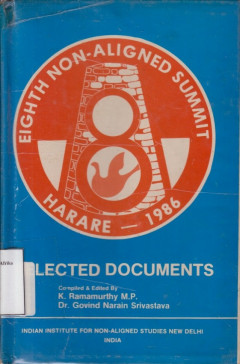
Eighth NAM summit: Selected documents
This volume compiles key official documents from the Eighth Summit of the Non-Aligned Movement (NAM), presenting resolutions, declarations, and policy statements adopted by member states. Edited by K. Ramamurthy and Dr. Srivastava, the book provides an essential reference on the political, economic, and international security concerns discussed during the summit. It highlights the collective po…
- Edisi
- -
- ISBN/ISSN
- -
- Deskripsi Fisik
- 267 pages : illustrations ; 21,5 cm
- Judul Seri
- -
- No. Panggil
- 327.172 RAM e

Peranan Indonesia sebagai pendiri Gerakan Non Blok dalam usaha memurnikan tuj…
The book "Indonesia's Role as the Founder of the Non-Aligned Movement in Efforts to Purify Its Goals and Principles" was published by the Research and Development Agency of the Ministry of Foreign Affairs of the Republic of Indonesia in 1986. This book discusses Indonesia's contribution to the birth of the Non-Aligned Movement (NAM) from the 1955 Asian-African Conference to the 1961 Belgrade Su…
- Edisi
- -
- ISBN/ISSN
- -
- Deskripsi Fisik
- iv, 145 pages : illustrations ; 23,5 cm
- Judul Seri
- -
- No. Panggil
- 327.172 BAD p
 Karya Umum
  Filsafat
  Agama
Agama  Ilmu-ilmu Sosial
  Bahasa
  Ilmu-ilmu Murni
  Ilmu-ilmu Terapan
  Kesenian, Hiburan, dan Olahraga
  Kesusastraan
  Geografi dan Sejarah