Ditapis dengan
Eastern and western world: Selected readings
This anthology presents a curated collection of selected readings designed to provide insight into the cultural, historical, and intellectual relationships between the Eastern and Western worlds. Published under the auspices of the Netherlands Universities Foundation for International Co-operation, the book brings together essays, scholarly reflections, and primary texts that explore themes of …
- Edisi
- -
- ISBN/ISSN
- -
- Deskripsi Fisik
- vii, 282 pages ; 19,5 cm
- Judul Seri
- -
- No. Panggil
- 303.482 HOF e

Yugoslavia in international relations and in the Non-Aligned movement
Edvard Kardelj's book Yugoslavia in International Relations and in the Non-Aligned Movement examines Yugoslavia's role in international relations and its contribution to the formation and development of the Non-Aligned Movement (NAM). As one of the main ideologues and architects of Yugoslavia's foreign policy, Kardelj explains how the country adopted a position independent of both the Western a…
- Edisi
- -
- ISBN/ISSN
- -
- Deskripsi Fisik
- 234 pages ; 20 cm
- Judul Seri
- -
- No. Panggil
- 327.172 KAR y
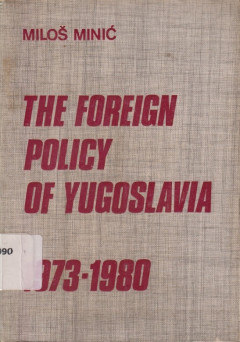
The Foreign policy of Yugoslavia 1973–1980
This book examines Yugoslavia's foreign policy during the period 1973–1980, when the country faced complex international dynamics amidst the Cold War. Miloš Minić, a prominent figure in Yugoslav diplomacy, outlines the principles of non-aligned foreign policy, relations with major powers, and Yugoslavia's role in multilateral diplomacy. This book serves as an important reference for underst…
- Edisi
- -
- ISBN/ISSN
- -
- Deskripsi Fisik
- 340 pages ; 20 cm
- Judul Seri
- -
- No. Panggil
- 327.495 MIN f
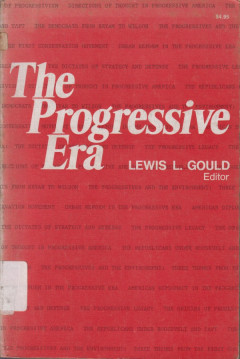
The Progressive era
This volume presents a comprehensive examination of the Progressive Era in the United States, a period marked by widespread political, social, and economic reform from the late nineteenth to early twentieth century. Edited by Lewis L. Gould, the collection brings together influential essays and analyses exploring the diverse motivations, leaders, and movements that shaped Progressive thought. I…
- Edisi
- -
- ISBN/ISSN
- 0-8156-2164-70-8156-2164-7
- Deskripsi Fisik
- x, 238 pages : illustrations ; 23 cm
- Judul Seri
- -
- No. Panggil
- 320.973 GOU p
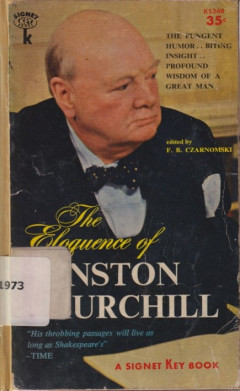
The Eloquence of Winston Churchill
This book is a collection of selected speeches by Winston Churchill, compiled and edited by F. B. Czarnomski. Through this compilation, readers can explore Churchill's rhetorical power and leadership in various political situations, especially during World War II and the period that followed. This collection showcases the language style, political vision, and decisiveness of a statesman known a…
- Edisi
- -
- ISBN/ISSN
- -
- Deskripsi Fisik
- xii, 200 pages ; 18 cm
- Judul Seri
- -
- No. Panggil
- 352.23092 CZA e
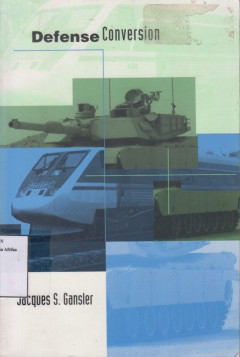
Defense conversion: Transforming the arsenal of democracy
Defense Conversion: Transforming the Arsenal of Democracy examines how the United States can shift its vast military-industrial infrastructure toward productive civilian uses after the Cold War. Jacques S. Gansler analyzes the challenges of converting defense-dependent industries, the economic impacts of reduced military spending, and the policy strategies needed to modernize America’s indust…
- Edisi
- -
- ISBN/ISSN
- 0-262-57116-1
- Deskripsi Fisik
- xiv, 277 pages : illustrations ; 23 cm
- Judul Seri
- -
- No. Panggil
- 338.476233 GAN d

Kegagalan CIA: Spionase amatiran sebuah negara adidaya
Kegagalan CIA adalah terjemahan dari Legacy of Ashes: The History of the CIA, karya jurnalis investigasi pemenang Pulitzer, Tim Weiner. Buku ini mengungkap sejarah panjang Central Intelligence Agency sejak berdirinya hingga abad ke-21, berdasarkan lebih dari 50.000 dokumen arsip dan ratusan wawancara dengan pejabat intelijen. Weiner menggambarkan bagaimana berbagai operasi CIA—mulai dari Pera…
- Edisi
- -
- ISBN/ISSN
- 978-979-22-3782-5
- Deskripsi Fisik
- xxiv, 832 halaman ; 23 cm
- Judul Seri
- -
- No. Panggil
- 327.1273 WEI k
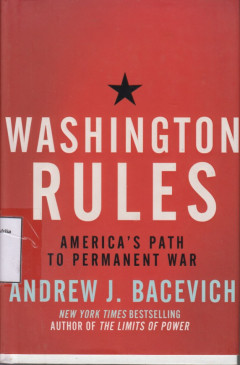
Washington rules: America’s path to permanent war
Washington Rules: America’s Path to Permanent War examines the long-standing foreign policy consensus that has shaped the United States’ global military posture since the mid-20th century. Andrew J. Bacevich argues that a deeply rooted set of strategic assumptions—maintained by political leaders, military institutions, and foreign-policy elites—has guided the nation toward continuous mi…
- Edisi
- -
- ISBN/ISSN
- 978-0-8050-9141-0
- Deskripsi Fisik
- 286 pages ; 22 cm
- Judul Seri
- -
- No. Panggil
- 355.033573 BAC w
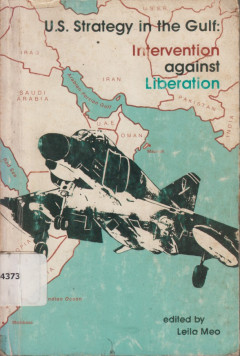
U.S. Strategy in the gulf: Intervention against liberation
bstract: This monograph analyzes United States strategic policies and military involvement in the Persian Gulf region during the period of regional upheaval. Edited by Leila Meo, the book examines the political motivations, geopolitical interests, and interventionist actions taken by the United States, particularly in relation to liberation movements and regional conflicts. It provides critic…
- Edisi
- -
- ISBN/ISSN
- 0-937694-50-9
- Deskripsi Fisik
- ii, 130 pages : illustrations ; 22,5 cm
- Judul Seri
- -
- No. Panggil
- 355.0335 MEO u

The Control of monopoly in the United Kingdom
This book comprehensively discusses the British government's policies in regulating and controlling monopolistic practices in the industrial sector. Paul H. Guénault and J. M. Jackson outline the legal framework, economic policies, and institutions involved in overseeing business competition in Britain in the mid-20th century. The analysis covers the background to the formation of anti-monopol…
- Edisi
- -
- ISBN/ISSN
- -
- Deskripsi Fisik
- ix, 197 pages ; 22 cm
- Judul Seri
- -
- No. Panggil
- 338.88 GUE c
 Karya Umum
  Filsafat
  Agama
Agama  Ilmu-ilmu Sosial
  Bahasa
  Ilmu-ilmu Murni
  Ilmu-ilmu Terapan
  Kesenian, Hiburan, dan Olahraga
  Kesusastraan
  Geografi dan Sejarah