Ditapis dengan

Foreign policy dynamics : Moscow and India's international conflicts
The book probes the impact of regime transformation--from the Soviet Union to Russia--on Moscow's foreign policy premises. What were post-Soviet Russia's attitudes towards India and particularly, on the proxy war in Kashmir? Interwoven into the study are conceptual delineations related to power status, image projection and interest convergence, which transcend cold-war/post-Soviet boundaries.
- Edisi
- -
- ISBN/ISSN
- 81-7629-137-4
- Deskripsi Fisik
- xiv, 257 pages : bibl: hlm 236-253 : index ; 23 cm
- Judul Seri
- -
- No. Panggil
- 327.54047 Var f
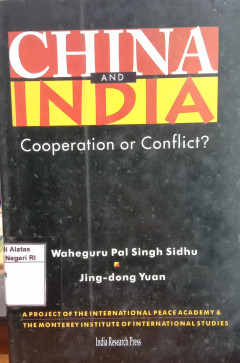
China and India: Cooperation or conflict?
The hardline view of Sino-Indian relations found in the published reports of Indian and Chinese security analysts is often at considerable odds with the more tempered opinions those same analysts express in private interviews and conversations. What is the reality of the increasingly important security relationship between the two countries? The authors of this new study address that question i…
- Edisi
- -
- ISBN/ISSN
- 8187943386
- Deskripsi Fisik
- xiii, 205 pages : bibl: hlm 183-195 : index ; 24 cm
- Judul Seri
- -
- No. Panggil
- 327.540 51 Sid c

Pakistan's foreign policy, 1947- 2005: A concise history
A distinguished career in Pakistan's Foreign Service has provided Abdul Sattar with a unique, personal insight into the making, implementation and consequences of Pakistan's foreign policy from Partition to post-9/11. This concise history reflects his knowledge and experience, providing a thorough account which will be of interest to both the layman and the scholar.
- Edisi
- First Published
- ISBN/ISSN
- 0-19-547167-9
- Deskripsi Fisik
- xii, 329 pages : illustrations, maps : bibl: hlm 321-322 : index ; 25 cm
- Judul Seri
- -
- No. Panggil
- 327.54 Sat p

India in a turbulent world: Perspective in foreign and security policies
- Edisi
- -
- ISBN/ISSN
- 81-7003-265-2
- Deskripsi Fisik
- xiv,321 Halaman : index ;21 cm
- Judul Seri
- -
- No. Panggil
- 327.54 Pat i
- Edisi
- -
- ISBN/ISSN
- 81-7003-265-2
- Deskripsi Fisik
- xiv,321 Halaman : index ;21 cm
- Judul Seri
- -
- No. Panggil
- 327.54 Pat i
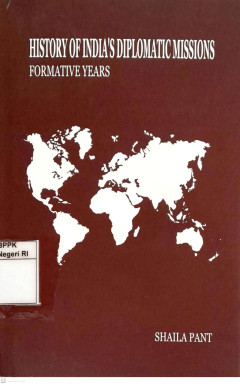
History of India's diplomatic missions: Formative years
The challenging task of executing, Nehru's vision of independent foreign policy required an innovative and dynamic diplomatic corp. The Indian state had the advantage of having a battery of officers drawn from British Raj, but could they translate the Nehruvian vision into practice? The history of evolution of Indian missions and their functioning provides an insight in to the dynamics of India…
- Edisi
- First Published
- ISBN/ISSN
- 81-902929-5-1
- Deskripsi Fisik
- ix, 201 pages : bibl: hlm 195-201 ; 23 cm
- Judul Seri
- -
- No. Panggil
- 327.54 Pan h
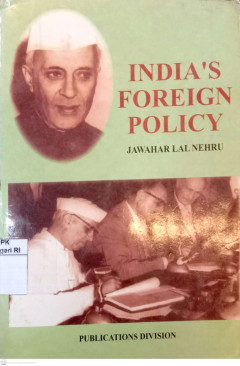
India's foreign policy: Jawaharlal Nehru
This book unfolds the story of India's foreign policy in the words of Jawaharlal Nehru, who has given it the present shape. He emphasizes that this policy is not of his own making, but is rooted in the nation's geography, history and culture.
- Edisi
- -
- ISBN/ISSN
- 80-230-1125-3
- Deskripsi Fisik
- 613 pages : index ; 23 cm
- Judul Seri
- -
- No. Panggil
- 327.54 Neh i

The long view from Delhi: To define the Indian grand strategy for foreign policy
Analyzing some of the major influences on foreign and security policy in India, this synthesis of insights assesses emerging global scenarios from an Indian perspective and details their likely impact on India's current and future national interests. This study first uses the Net Assessment method to detail the scenarios_that the country will face in 2020 and then utilizes a transparent method …
- Edisi
- -
- ISBN/ISSN
- 9788171888009
- Deskripsi Fisik
- 182 pages : 29 cm
- Judul Seri
- -
- No. Panggil
- 327.54 Men l
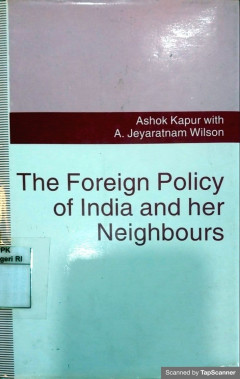
Foreign policy of India and her neighbours
This study of perceptions, interests and strategies of South Asian states reveals the analytical and empirical richness of three kinds of states in the region: India - the regional hegemon; Pakistan-India's permanent competitor; and other South Asian states who do not accept Pakistani perceptions, interests and strategies concerning India. This book assesses the diplomatic and strategic princip…
- Edisi
- First Published
- ISBN/ISSN
- 0-333-55829-4
- Deskripsi Fisik
- ix, 186 pages : illustrations : index ; 23 cm
- Judul Seri
- -
- No. Panggil
- 327.54 Kap f

India's foreign policy: Nehru to Rao
India's foreign policy is a culmination of the past ways of thinking of the people and the past declarations of their leaders. The stand of the Indian National Congress at its Madras Session 1927 was very much against the use of India as a base for the Britishers launching attacks on the freedom of other people. Shri Jawaharlal Nehru, the first Prime Minister of Independent India, was a partici…
- Edisi
- -
- ISBN/ISSN
- -
- Deskripsi Fisik
- x, 184 pages : illustrations : index ; 23 cm
- Judul Seri
- -
- No. Panggil
- 327.54 Jos i
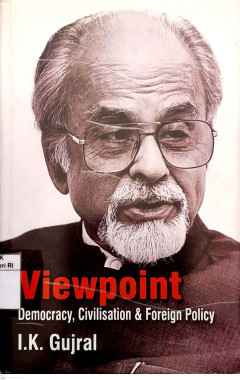
Viewpoint: Democracy, Civilisation and foreign policy
The French Revolution broke down the barriers of class and estate. It propelled the world forward into the modern age, one that placed the individual at the centre of the political system, and gave birth to the modern Republic and to the nation state. We in India have been keen students of the Revolution and the subsequent development of democratic institutions in France.
- Edisi
- -
- ISBN/ISSN
- 81-7764-626-5
- Deskripsi Fisik
- viii, 292 pages : ilustrations : index ; 25 cm
- Judul Seri
- -
- No. Panggil
- 327.54 Guj v
 Karya Umum
  Filsafat
  Agama
Agama  Ilmu-ilmu Sosial
  Bahasa
  Ilmu-ilmu Murni
  Ilmu-ilmu Terapan
  Kesenian, Hiburan, dan Olahraga
  Kesusastraan
  Geografi dan Sejarah