Ditapis dengan
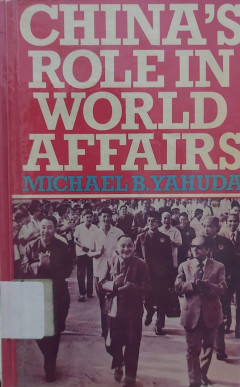
China's role in world affairs
This book analyzes China’s role in international politics and world affairs during the Cold War period. It examines China’s foreign policy behavior, ideological foundations, and diplomatic strategies, highlighting how domestic political factors and global power structures shaped China’s interaction with both developing and developed countries
- Edisi
- -
- ISBN/ISSN
- 0-19-827256-1
- Deskripsi Fisik
- 298 pages ; 21,5 cm
- Judul Seri
- -
- No. Panggil
- 327.51 YAH c

China's future: Foreign policy and economic development in the post-Mao era
This book analyzes China’s foreign policy and economic development in the period following the death of Mao Zedong. Written within the framework of the Council on Foreign Relations’ 1980s Project, the study examines how domestic economic reforms and international strategic considerations shaped China’s evolving role in global politics. The authors explore policy choices, external relation…
- Edisi
- -
- ISBN/ISSN
- 0-07-069958-5
- Deskripsi Fisik
- xiv, 202 pages ;23 cm
- Judul Seri
- -
- No. Panggil
- 327.51 WHI c
Cultural policy in Tunisia
This book analyzes the development and implementation of cultural policy in Tunisia within the context of national modernization and post-independence state-building. It examines the role of government institutions in promoting cultural activities, preserving national heritage, and supporting artistic creation. The study also discusses the relationship between culture, education, and social dev…
- Edisi
- -
- ISBN/ISSN
- 92-3-100850-1
- Deskripsi Fisik
- 56 pages : illustration ; 24 cm
- Judul Seri
- -
- No. Panggil
- 353.7 SAI c

Economy and society in pre-industrial South Africa
Over the past forty years there has been a revolution in South African historiography, yet no broadly interpretative essay on South African history has appeared. The essays in this volume aim to provide such a reinterpretation for the nineteenth century before the discovery of minerals transformed the nature of South African societies, and help to shed light on earlier phases of South Africa's …
- Edisi
- -
- ISBN/ISSN
- 0-582-64656-1
- Deskripsi Fisik
- 385 pages ; 22 cm
- Judul Seri
- -
- No. Panggil
- 330.68 MAR e
The Future of China After Mao
Examines China's future and political balance of power by analyzing the goals and methods of Hua Kuo-feng, Mao's successor, together with domestic problems, social and economic developments, and foreign relations
- Edisi
- -
- ISBN/ISSN
- 0-440-52612-4
- Deskripsi Fisik
- xiv, 331 pages : illustration ; 20 cm
- Judul Seri
- -
- No. Panggil
- 323.531 TER f

The Chinese military system: An Organizational study of the Chinese people's …
This book provides a comprehensive organizational analysis of the Chinese People’s Liberation Army (PLA). It examines the structure, command system, political control, and functional roles of China’s military within the framework of a socialist state. The study explores the relationship between the Communist Party and the armed forces, highlighting how ideology, organization, and civil–mi…
- Edisi
- -
- ISBN/ISSN
- 0-89158-221-5
- Deskripsi Fisik
- xi, 266 pages ; 23 cm
- Judul Seri
- -
- No. Panggil
- 355.00951 NEL c

Yà fēi xióngfēng: Tuánjié hézuò de yà fēi huìyì
This book examines the journey and influence of the series of Asia-Africa conferences (including the Bandung conference and related meetings) as a forum for solidarity between Asian and African countries after the war/decolonization. Main themes include the spirit of unity, cooperation, and opposition to colonialism, an analysis of the political decisions that emerged from these conferences, an…
- Edisi
- -
- ISBN/ISSN
- 7-5012-0903-0
- Deskripsi Fisik
- 250 pages : illustrations ; 20 cm
- Judul Seri
- -
- No. Panggil
- 327.1 XIA y
The Politics of Palestinian nationalism
William B. Quandt's The Politics of Palestinian Nationalism examines the development of political ideas, organizations, and the struggle of Palestinian nationalism from the early 20th century to the contemporary period. The book explores how Palestinian national identity was shaped by the experience of colonialism, regional conflicts, the influence of international powers, and the internal dyna…
- Edisi
- -
- ISBN/ISSN
- 0-520-02336-6
- Deskripsi Fisik
- viii, 234 pages; 23 cm
- Judul Seri
- -
- No. Panggil
- 320.956 QUA p

Peranakan Chinese politics in java: 1917-1942
This book explores the political dynamics of the Peranakan Chinese community in Java between 1917 and 1942. Based on newspaper archives, pamphlets, and personal interviews, the author identifies three main political currents among the Peranakan: the China-oriented current (Sin Po Group), the Dutch-oriented current (Chung Hwa Hui / CHH), and the Indonesia-oriented current (Partai Tionghoa Indone…
- Edisi
- Revised edition
- ISBN/ISSN
- 9971-69-037-3
- Deskripsi Fisik
- xvii, 193 pages : ilustrations ; 21,5 cm
- Judul Seri
- -
- No. Panggil
- 323.119510598 SUR p
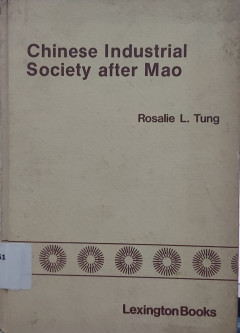
Chinese industrial society after Mao
This book examines the transformation of Chinese industrial society in the period following the death of Mao Zedong. It analyzes changes in industrial organization, labor relations, management practices, and social structures within China’s state-led economy after 1976. Drawing on economic, sociological, and political perspectives, the study provides insight into how post-Mao reforms reshaped…
- Edisi
- -
- ISBN/ISSN
- 0-669-04565-9
- Deskripsi Fisik
- xvi, 357 pages ; 22 cm
- Judul Seri
- -
- No. Panggil
- 338.0951 TUN c
 Karya Umum
  Filsafat
  Agama
Agama  Ilmu-ilmu Sosial
  Bahasa
  Ilmu-ilmu Murni
  Ilmu-ilmu Terapan
  Kesenian, Hiburan, dan Olahraga
  Kesusastraan
  Geografi dan Sejarah