Ditapis dengan

After the cataclysm: Postwar Indochina and the reconstruction of imperial ide…
After the Cataclysm examines the political, social, and ideological aftermath of the Indochina wars, focusing on Vietnam, Cambodia, and Laos following the withdrawal of the United States. Chomsky and Herman analyze how Western media and political institutions constructed narratives about postwar Indochina to justify American foreign policy and sustain Cold War ideological frameworks. The book c…
- Edisi
- -
- ISBN/ISSN
- 0-89608-100-1
- Deskripsi Fisik
- 392 pages ; 21 cm
- Judul Seri
- -
- No. Panggil
- 959.704 CHO a

Failed states: The Abuse of power and the assault on democracy
In this book, Noam Chomsky argues that the United States increasingly exhibits the characteristics of a “failed state”—one that disregards international law, undermines democratic principles, and relies on military force to pursue global dominance. Chomsky examines U.S. foreign policy after 2001, focusing on unilateral actions, the Iraq War, counterterrorism strategies, and the erosion of…
- Edisi
- -
- ISBN/ISSN
- 978-0-8050-7912-8
- Deskripsi Fisik
- 311 pages ; 24 cm
- Judul Seri
- -
- No. Panggil
- 327.73 CHO f

Failed states: The abuse of power and the assault on democracy
The United States has repeatedly asserted its right to intervene militarily against "failed states" around the globe. Chomsky turns the tables, charging the United States with being a "failed state," and therefore a danger to its own people and the world. "Failed states," Chomsky writes, are those "that do not protect their citizens from violence and perhaps even destruction, that regard themse…
- Edisi
- 1st edition
- ISBN/ISSN
- 978-0-7394-7187-6
- Deskripsi Fisik
- 311 pages : index ; 21 cm.
- Judul Seri
- -
- No. Panggil
- 327 Cho f
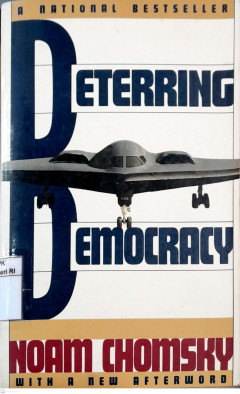
Deterring democracy: With a new afterword
History does not come neatly packaged into distinct periods, but by imposing such a structure upon it, we can sometimes gain clarity without doing too much violence to the facts. One such period was initiated with the Second World War, a new phase in world affairs in which "the United States was the hegemonic power in a system of world order" (Harvard government professor and foreign policy adv…
- Edisi
- -
- ISBN/ISSN
- 0-374-52349-5
- Deskripsi Fisik
- viii, 455 pages : index ; 24 cm
- Judul Seri
- -
- No. Panggil
- 327.73 Cho d
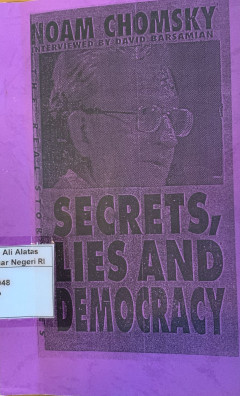
Secrets, lies and democracy
Another illusion-shattering piece from the man "The New York Times" called "arguably the most important intellectual alive". In 1970, about 90 per cent of international capital was used for trade and long-term investment - more or less productive things - and 10 per cent for speculation. By 1990, these figures had reversed. Haiti, a starving island, is exporting food to the US - about 35 times …
- Edisi
- First Published
- ISBN/ISSN
- 978-1-878-82504-9
- Deskripsi Fisik
- 128 pages ; 21 cm.
- Judul Seri
- -
- No. Panggil
- 330.9048 Cho s

Manufacturing consent: The political economy of the mass media
In this pathbreaking work, Edward S. Herman and Noam Chomsky show that, contrary to the usual image of the news media as cantankerous, obstinate, and ubiquitous in their search for truth and defense of justice, in their actual practice they defend the economic, social, and political agendas of the privileged groups that dominate domestic society, the state, and the global order. Based on a s…
- Edisi
- -
- ISBN/ISSN
- 0-375-71449-9
- Deskripsi Fisik
- lxiv, 412 pages : index ; 23,5 cm
- Judul Seri
- -
- No. Panggil
- 330.9 Her m
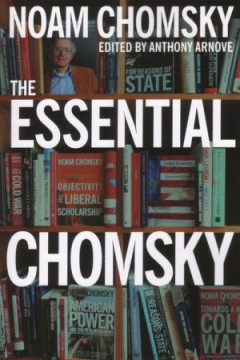
The essential Chomsky
One of the World's most prominent public intellectuals, Noam Chomsky has, in more than fifty years of writing on politics, philosophy, and language, revolutionized modern linguistics and established himself as one of the most original and wide-ranging political and social critics of our time. The Essential Chomsky brings together selections from his most important writings since 1959 - from his…
- Edisi
- -
- ISBN/ISSN
- 978-1-59558-189-1
- Deskripsi Fisik
- ix, 515 pages : index ; 23 cm
- Judul Seri
- -
- No. Panggil
- 320 Cho e
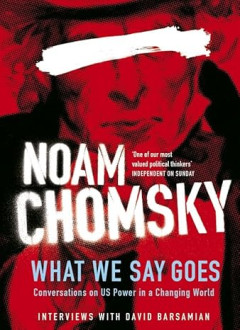
What we say goes: Conversations on US power in a changing world
In this new collection of conversations, conducted in 2006 and 2007, Noam Chomsky explores the most immediate and urgent concerns: Iran’s challenge to the United States, the deterioration of the Israel-Palestine conflict, the ongoing occupations of Iraq and Afghanistan, the rise of China, and the growing power of the left in Latin America, as well as the Democratic victory in the 2006 U.S. mi…
- Edisi
- -
- ISBN/ISSN
- 978-0-241-14401-5
- Deskripsi Fisik
- v, 223 pages : index ; 18 cm
- Judul Seri
- -
- No. Panggil
- 158.3 Cho w
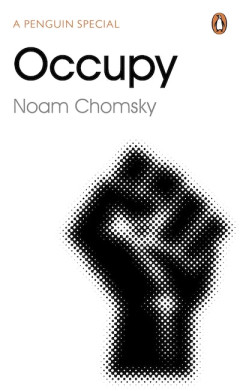
Occupy
Since its appearance in Zuccotti Park, New York, in September 2011, the Occupy movement has spread to hundreds of towns and cities across the world. No longer occupying small tent camps, the movement now occupies the global conscience as its messages spread from street protests to op-ed pages to the highest seats of power. From the movement's onset, Noam Chomsky has supported its critique of co…
- Edisi
- -
- ISBN/ISSN
- 978-0-241-96401-9
- Deskripsi Fisik
- 122 pages : illustrations (black and white) ; 18 cm
- Judul Seri
- -
- No. Panggil
- 320 Cho o
 Karya Umum
  Filsafat
  Agama
Agama  Ilmu-ilmu Sosial
  Bahasa
  Ilmu-ilmu Murni
  Ilmu-ilmu Terapan
  Kesenian, Hiburan, dan Olahraga
  Kesusastraan
  Geografi dan Sejarah