Ditapis dengan

New Zealand foreign policy: Statement and documents, 1943-1957
This book is a compilation of official statements and key diplomatic documents outlining the development of New Zealand’s foreign policy from 1943 to 1957. Issued by the Ministry of Foreign Affairs, it covers New Zealand’s international stance during and after World War II, including its role in global diplomacy, regional security, and participation in international organizations. The volum…
- Edisi
- -
- ISBN/ISSN
- -
- Deskripsi Fisik
- 495 pages ; 25 cm
- Judul Seri
- -
- No. Panggil
- 327.931 MIN n

UNESCO world cultural heritage in the Czech Republic
The UNESCO World Cultural Heritage in the Czech Republic book, published by the Czech Ministry of Foreign Affairs, serves as official documentation of UNESCO World Cultural Heritage sites located within the country. The book describes the history, architectural significance, and importance of preserving a number of historic sites, complete with photographs and brief descriptions of each site. P…
- Edisi
- -
- ISBN/ISSN
- 80-86012-05-0
- Deskripsi Fisik
- 63 pages : illustration ; 21 cm
- Judul Seri
- -
- No. Panggil
- 943.7 MIN u

The People’s Republic of China Foreign Affairs archives compilation (Volume…
This volume presents a curated selection of diplomatic archives from the Ministry of Foreign Affairs of the People’s Republic of China, focusing on the Chinese delegation’s participation in the 1955 Asian-African Conference in Bandung. The documents provide insights into China’s foreign policy strategies, diplomatic interactions, preparatory communications, and the geopolitical context su…
- Edisi
- -
- ISBN/ISSN
- -
- Deskripsi Fisik
- 260 pages : illustrations ; 24,5 cm
- Judul Seri
- -
- No. Panggil
- 327.51 MIN p

New Zealand foreign policy: Statements and documents, 1943–1957
New Zealand Foreign Policy: Statements and Documents, 1943–1957 is an official compilation issued by the Ministry of Foreign Affairs, presenting key policy statements, diplomatic correspondence, and government positions during a critical period of New Zealand’s international engagement. Covering the years from World War II through early Cold War developments, the volume provides insight int…
- Edisi
- -
- ISBN/ISSN
- -
- Deskripsi Fisik
- 495 pages ; 25 cm
- Judul Seri
- -
- No. Panggil
- 327.931 MIN n

Queen Sirikit: The Jewel of the kingdom
Queen Sirikit: The Jewel of the Kingdom presents a richly illustrated tribute to Her Majesty Queen Sirikit of Thailand, highlighting her lifelong dedication to national development, cultural preservation, and humanitarian service. Published by the Ministry of Foreign Affairs, the book documents the Queen’s pivotal role in promoting Thai arts, crafts, and traditional culture, particularly thro…
- Edisi
- -
- ISBN/ISSN
- 974-7709-11-2
- Deskripsi Fisik
- 155 pages : ilustrations ; 31 cm
- Judul Seri
- -
- No. Panggil
- 923.1593 MIN q
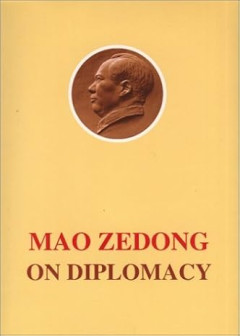
Mao Zedong on diplomacy
Mao Zedong was a great diplomatic strategist of modern times. As the chief leader of the Communist Party and People's Republic of China, he laid out principles of external affairs and diplomatic strategies, tactics and policies during the War of Resistance Against Japan (1937-1945) and the War of Liberation (1946-1949). For 27 years after the founding of the People's Republic he made significan…
- Edisi
- Ed. 1 ; Cet. 2
- ISBN/ISSN
- 978-7-119-01141-7
- Deskripsi Fisik
- viii, 498 pages ; 22 cm
- Judul Seri
- -
- No. Panggil
- 923.2 Chi m
Indonesia and its Foreign policy
Indonesia's foreign policy is characterized by its commitment to an independent and active role in international affairs. This compilation explores the core principles, objectives, and key features of Indonesia's foreign policy. It emphasizes Indonesia's pursuit of a free and active foreign policy, its adherence to the principles of non-alignment and diplomacy, and its dedication to regional st…
- Edisi
- -
- ISBN/ISSN
- -
- Deskripsi Fisik
- 36 pages ; 22 cm
- Judul Seri
- -
- No. Panggil
- 327.9598 Ind i
United Nations handbook 1996
The 1996 United Nations Handbook comes at a time when the United Nations faces critical questions about its future. The united Nations first 50 years have seen some impressive achievements.
- Edisi
- -
- ISBN/ISSN
- 0-477-03745-3
- Deskripsi Fisik
- 361 pages : illustrations (black and white) ; 23 cm
- Judul Seri
- -
- No. Panggil
- 341.23 New u
United Nations handbook 2001
Explained what happened in the United Nations in 2001. contents: 1. General assembly 2. Security council 3. Economic and social council 4. Trusteeship council 5. International court of justice 6. Secretariat 7. Other bodies subsidiary or related to the UN.
- Edisi
- -
- ISBN/ISSN
- 0-477-03761-5
- Deskripsi Fisik
- 388 pages : illustrations (black and white) ; 23 cm
- Judul Seri
- -
- No. Panggil
- 341.23 New u
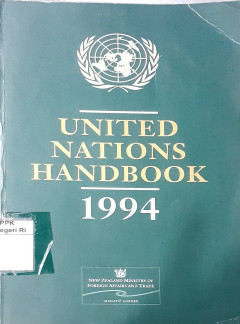
United Nations handbook 1994
The United Nations Handbook is a ready reference guide for delegates, diplomats and foreign ministry officials concerned with UN matters. It is also widely used by the media and non-govermental organisations with an interest in the UN.
- Edisi
- -
- ISBN/ISSN
- 0110-1951
- Deskripsi Fisik
- 294 pages ; 23 cm
- Judul Seri
- -
- No. Panggil
- 341.23 New u
 Karya Umum
  Filsafat
  Agama
Agama  Ilmu-ilmu Sosial
  Bahasa
  Ilmu-ilmu Murni
  Ilmu-ilmu Terapan
  Kesenian, Hiburan, dan Olahraga
  Kesusastraan
  Geografi dan Sejarah