Ditapis dengan

The new Asian hemisphere: The irresistible shift of global power to The East
For centuries, the Asians (Chinese, Indians, Muslims, and others) have been bystanders in world history. Now they are ready to become co-drivers. Asians have finally understood, absorbed, and implemented Western best practices in many areas: from free-market economics to modern science and technology, from meritocracy to rule of law. They have also become innovative in their own way, creating …
- Edisi
- -
- ISBN/ISSN
- 978-1-58648-466-8
- Deskripsi Fisik
- x, 314 pages : illustrations : index ; 21 cm
- Judul Seri
- -
- No. Panggil
- 327.5 Mah n

Asia hemisfer baru dunia : Pergeseran kekuatan global ke timur yang tak terlu…
Dalam buku Asia Hemisfer Baru Dunia: Pergeseran Kekuatan Global ke Timur yang Tak Terelakkan, Kishore Mahbubani mengulas dengan bukti-bukti keberhasilan negara di Asia yang berkembang menjadi kekuatan utama dunia, terutama China dan India. Namun, yang menjadi ironi adalah ketika kekuatan-kekuatan baru dari Asia itu tumbuh dengan mengadopsi nilai-nilai Barat, kini justru Barat mulai merasa teran…
- Edisi
- -
- ISBN/ISSN
- 978-979-709-608-3
- Deskripsi Fisik
- xx, 362 halaman : illustrations (black and white) : index ; 23 cm
- Judul Seri
- -
- No. Panggil
- 330.95 Mah a

Beyond the age of innocence
After publishing articles in leading American journals for over two decades, Kishore Mahbubani was described as "an Asian Toynbee, preoccupied with the rise and fall of civilizations" by The Economist. Trained in philosophy in North America and Asia, and well-experienced in real politik as a diplomat on the world stage, Mahbubani has unusual insight into America's ever more troubled relationshi…
- Edisi
- -
- ISBN/ISSN
- 1-58648-268-8
- Deskripsi Fisik
- xx, 235 pages : illustration : index ; 23 cm
- Judul Seri
- -
- No. Panggil
- 327. 73 Mah b

The ASEAN miracle : A catalyst for peace
The Association of Southeast Asian Nations (ASEAN) is a miracle. In an era of growing cultural pessimism, there is a pervasive belief that different civilizations cannot function together. Yet the ten countries of ASEAN are a thriving counter-example of coexistence. Here, more than 625 million people live together in peace. In 1967, leaders from Indonesia, Malaysia, the Philippines, Singapor…
- Edisi
- -
- ISBN/ISSN
- 978-981-4722-49-0
- Deskripsi Fisik
- xvi, 264 : illustrations (black and white) ; 23 cm
- Judul Seri
- -
- No. Panggil
- 352.114 Mah a
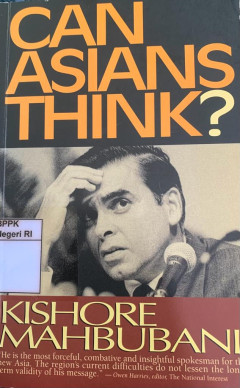
Can Asians think?
Can Asians think? Are we at the end of the Western epoch? Is Western civilisation universal? Does the West promote human rights for altruistic reasons? Is Japan adrift? Why has Southeast Asia not become the Balkans of Asia? These are some of the questions Kishore Mahbubani has sought to answer in his personal ruminations over the years. This volume of essays and speeches brings together for the…
- Edisi
- -
- ISBN/ISSN
- 981-204-968-1
- Deskripsi Fisik
- 192 pages ; 20 cm
- Judul Seri
- -
- No. Panggil
- 320.950 Mah c
 Karya Umum
  Filsafat
  Agama
Agama  Ilmu-ilmu Sosial
  Bahasa
  Ilmu-ilmu Murni
  Ilmu-ilmu Terapan
  Kesenian, Hiburan, dan Olahraga
  Kesusastraan
  Geografi dan Sejarah