Ditapis dengan
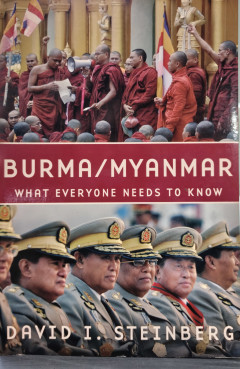
Burma/Myanmar: what everyone needs to know
Burma/Myanmar: What Everyone Needs to Know by David I. Steinberg provides a concise introduction to Burma/Myanmar, a country with an ancient civilization, extraordinary ethnic diversity, and a strategically important location between China and India. Over the past two decades, the country has frequently attracted international attention due to political crises, military authoritarian rule, one …
- Edisi
- -
- ISBN/ISSN
- 978-0-19-5390067-4
- Deskripsi Fisik
- xxxi, 216 hlm. ; 21 x 14 cm
- Judul Seri
- -
- No. Panggil
- 959.1 Ste b

The New Brazil
This book examines Brazil's transformation from a backward Portuguese colony to a dynamic developing nation, particularly since its economic reshaping following a serious crisis at the end of the 20th century. Roett explains how monetary reforms, tighter fiscal policies, and political stability propelled Brazil into a regional power and a significant actor in international relations. This work …
- Edisi
- -
- ISBN/ISSN
- 978-0-8157-2168-0
- Deskripsi Fisik
- xv, 176 pages : illustration ; 23 cm
- Judul Seri
- -
- No. Panggil
- 330.981 ROE n

Subversion as foreign policy: The secret Eisenhower and Dulles debacle in Ind…
This account of US foreign policy reveals the story of the covert activity in Indonesia undertaken by President Eisenhower and Secretary of State John Foster Dulles in the late 1950s
- Edisi
- Cetakan pertama
- ISBN/ISSN
- 1-56584-244-8
- Deskripsi Fisik
- 318 pages : maps : index ; 25 cm
- Judul Seri
- -
- No. Panggil
- 327.598073 Kah s

Enhancing The Competitiveness Of Indonesian Migrant Workers: A Strategy For P…
Indonesian migrant workers contribute significantly to the national economy through remittances, local economic development, and unemployment reduction. However, limited skills and competitiveness remain major challenges in facing international labour market competition. The COVID-19 pandemic has further disrupted efforts to improve human resource quality. This study aims to formulate policy re…
- Edisi
- -
- ISBN/ISSN
- -
- Deskripsi Fisik
- -
- Judul Seri
- -
- No. Panggil
- Sesparlu 67-2021

Indonesia-Cambodia: Forging ties through thick and thin
This book is comprehensive account of the close relations and cooperation between two Asian countries and the vicissitudes as well as the triumphs of that relationship. The friendship between the Kingdom of Cambodia and the Republic of Indonesia are founded on cultural, social and political ties that have deep historical roots.
- Edisi
- -
- ISBN/ISSN
- 9799634296
- Deskripsi Fisik
- xxi, 281 pages : illustration ; 22 cm
- Judul Seri
- -
- No. Panggil
- 327. 095989596 Nas i

Indigenous Aspect In Ongoing Negotiations Of Indonesia-Canada Free Trade Agre…
The focus Indonesia-Canada bilateral relations since 1950s is economy. Despite this, both countries need more than sixty years to decide that they need to foster their economic relations. Nevertheless, it is not easy for both countries to move forward. The first obstacle was the Neil Bantleman’s case during 2015-2019. The second one is in the ongoing negotiations of Indonesia-Canada Free Trad…
- Edisi
- -
- ISBN/ISSN
- -
- Deskripsi Fisik
- -
- Judul Seri
- -
- No. Panggil
- Sesparlu 67-2021

Indonesia’S Post Covid-19: Boosting Economic Development Through Indonesia …
The COVID-19 pandemic has triggered a global economic slowdown, disrupted international trade, and constrained global supply chains and investment flows. In response, investment has become a key instrument for Indonesia’s national economic recovery. One of the government’s policy measures was the establishment of the Indonesia Investment Authority (INA), a Sovereign Wealth Fund (SWF) design…
- Edisi
- -
- ISBN/ISSN
- -
- Deskripsi Fisik
- -
- Judul Seri
- -
- No. Panggil
- Sesparlu 67-2021

Developing Indonesia’S Capacity In Milk Production And Industry: Learning F…
Indonesia’s palm oil industry continues to face negative allegations concerning environmental degradation, deforestation, and biodiversity loss, despite ongoing efforts by various stakeholders to promote sustainable practices. Through the Ministry of Foreign Affairs, Indonesia has pursued palm oil diplomacy to safeguard market access and strengthen the international position of this strategic…
- Edisi
- -
- ISBN/ISSN
- -
- Deskripsi Fisik
- -
- Judul Seri
- -
- No. Panggil
- Sesparlu 67-2021

Boosting Indonesia’S Car Exports Through Indonesia-Australia Comprehensive …
The Indonesian Government has put the Automotive industry as one of its priority sector in achieving “Indonesia 4.0” and the mid-term goal of improving Indonesia’s economy to be the 10th largest in the world by year 2030. More specifically, the ICE vehicles export should improve to reach 1 million units per year by 2025, and for the EV industry to be developed and starts producing and e…
- Edisi
- -
- ISBN/ISSN
- -
- Deskripsi Fisik
- -
- Judul Seri
- -
- No. Panggil
- Sesparlu 67-2021

Promoting State-Owned Enterprise Going Global: Refocusing Indonesia Economic …
The development of non-traditional markets has become an important strategy for Indonesia to expand its international trade networks and support national economic recovery through the overseas expansion of state-owned enterprises (SOEs). The Balkan region offers potential as an alternative market for Indonesian export commodities, although Indonesia’s economic relations with countries in the …
- Edisi
- -
- ISBN/ISSN
- -
- Deskripsi Fisik
- -
- Judul Seri
- -
- No. Panggil
- Sesparlu 67-2021
 Karya Umum
 Filsafat
 Agama
 Ilmu-ilmu Sosial
 Bahasa
 Ilmu-ilmu Murni
 Ilmu-ilmu Terapan
 Kesenian, Hiburan, dan Olahraga
 Kesusastraan
 Geografi dan Sejarah